Why It’s Hard to Relax
Have you ever noticed that you can finally lie down at the end of the day, only to discover that you can’t relax? Your body is exhausted, but your mind keeps racing. You crave rest, yet something inside you feels like it has to stay alert, productive, or ready for whatever comes next.
If that sounds familiar, you’re not alone. Many of us have spent years living with chronic stress, and over time our nervous system begins to accept that state as normal. We push through fatigue, ignore the signals our bodies are sending, and wonder why meditation, positive thinking, or an occasional vacation doesn’t seem to create lasting change.
The truth is, your nervous system isn’t responding to logic. It’s responding to whether it feels safe.
Our nervous system is constantly scanning our environment for signs of danger or safety. This process happens automatically, without us even realizing it. When the brain perceives a threat—whether an actual emergency or simply ongoing stress—it shifts us into a protective state. Our heart rate increases, our muscles tighten, our breathing becomes shallow, and stress prepares us to fight, flee, or freeze.
The good news is that our nervous system is also designed to return to balance. It simply needs practice—and experiences that communicate, “You’re safe now.
Sound Supports the Nervous System
One of the most beautiful ways I’ve found to support stress-relief and a return to balance is through sound.
During a sound bath, you’re not being asked to do anything. There’s nothing to figure out, no thoughts to control, and no expectation that you’ll “do relaxation correctly.” Instead, you simply allow yourself to listen and flow.
As the sounds of singing bowls, gongs, chimes, and ocean drums fill the space, your attention naturally begins to settle. Your breathing slows. Your muscles soften. The constant mental chatter begins to quiet—not because you’re forcing it to stop, but because your body is receiving different information.
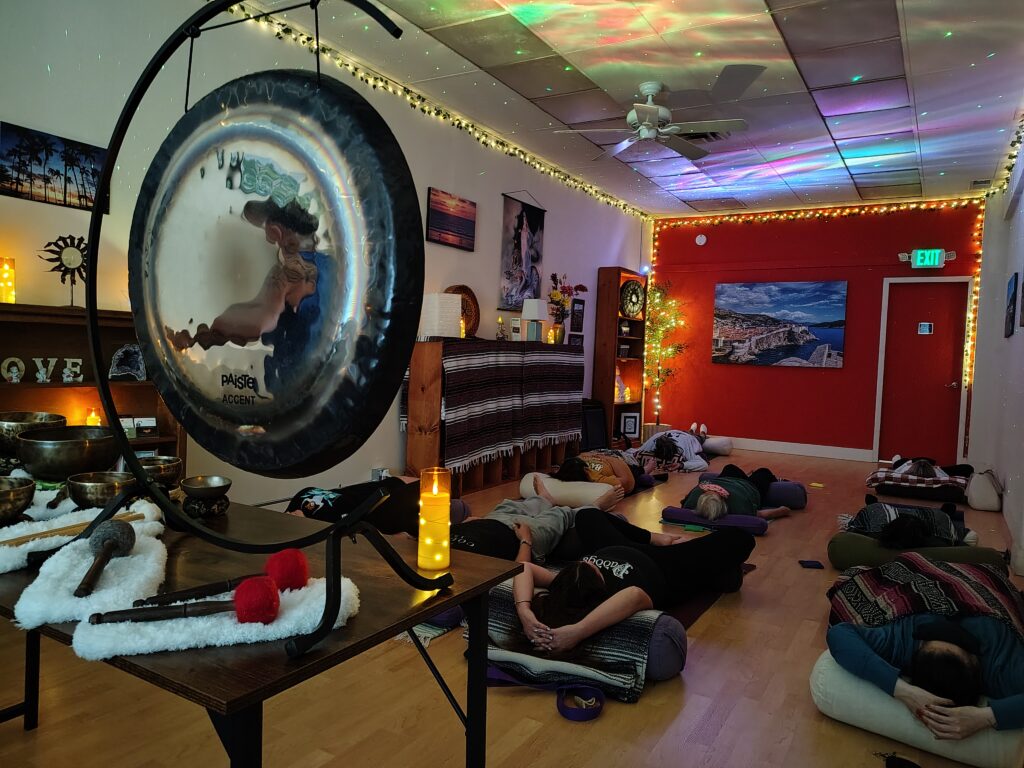
Many people are curious about what actually happens during a sound bath, especially if they’ve never experienced one before. There is no experience required and no special way to participate. You’ll simply make yourself comfortable, usually lying down with a yoga mat, blanket, and pillow, and allow yourself to receive the sound. Some people drift into a deeply relaxed state. Others remain aware of everything happening around them. Some notice physical sensations, emotions, memories, or a sense of deep peace. Every experience is different, and there is no right or wrong way to receive.
The invitation is simply to slow down, listen, and give your body space to rest.
The Vagus Nerve and Sound Baths
Part of why sound baths may feel so calming involves the vagus nerve. You can think of the vagus nerve as a communication pathway between your brain and many of your major organs, including your heart, lungs, and digestive system. When this pathway is supported, the body can begin moving toward a state of calm, restoration, and recovery.
While research is still evolving, studies suggest that practices such as slow breathing, intentional listening, soothing sounds, and certain low-frequency vibrations may help engage the vagus nerve and send signals of safety to the nervous system. In practical terms, this may help the body move out of a constant state of vigilance and toward a more settled, regulated state.
Sound healing isn’t a medical treatment, but many people find it to be a gentle and supportive practice for helping their nervous system slow down, release tension, and reconnect with a sense of calm. Many guests also share that they experience deeper relaxation and more restorative sleep after a sound bath.
Why Emotions May Surface
People often ask me why emotions sometimes arise during a sound bath. Someone may unexpectedly cry, feel waves of joy, remember a long-forgotten experience, or even drift into a deep state of rest.
This is what a sound bath is designed to support: creating a sense of safety where your body can soften, your nervous system can settle, and whatever needs your attention can gently come to the surface.
When the nervous system experiences enough safety, it can begin to release some of the tension it has been carrying. Emotions, memories, or sensations that have been quietly waiting beneath the surface may have space to be felt and acknowledged.
Every person’s experience is unique, and there is no “right” way to respond. Whatever arises is simply information from your body, offering insight into what may need attention, support, or care.
Regulation Isn’t Constant Calm
One of the biggest misconceptions about nervous system regulation is that it means feeling calm all the time.
It doesn’t.
A regulated nervous system isn’t one that never experiences stress. It’s one that can move through stress and return to balance afterward.
Resilience isn’t the absence of stress; it’s the ability to reconnect with ourselves after difficult moments. The more we practice returning to a place of balance, calm, and ease, the more familiar that state becomes—and the easier it is to find our way back.
Life can throw a lot at us sometimes. When we are constantly living at the surface, it can feel like we’re being tossed around by every wave—the demands, the worries, the unexpected challenges. But when we learn how to move beneath the surface, we discover a place within us that is quieter and steadier.
From that place, we can hear our own inner wisdom more clearly. We can respond instead of react. We can meet life from a place of presence rather than being swept away by every storm.
You Don’t Have to Earn Rest
I also believe we’ve been taught to think about rest all wrong.
Many of us learned that rest is something we earn after we’ve finished everything on our to-do list. But the truth is, my list is rarely finished. Is yours?
Rest isn’t a reward for productivity.
It’s one of the things that allows us to live, work, love, and show up more fully in our lives. When we support our nervous system, we’re not running away from life—we’re creating the inner space to meet it with more presence, clarity, and ease.
Whether you experience that sense of regulation through sound, time in nature, meditation, gentle movement, or quiet moments alone, the important thing is to give your nervous system regular opportunities to experience safety and balance.
Each time you do, you strengthen your ability to return to center, recover from stress, and respond to life with greater resilience. Perhaps the greatest gift is learning that no matter what storms move through your life, you carry an inner compass that can always guide you back to yourself.



0 Comments